• Navigation überspringen
  • Zur Navigation
  • Zum Seitenende
Organisationsmenü öffnen Organisationsmenü schließen
  • FAUZur zentralen FAU Website
  1. Friedrich-Alexander-Universität
  2. Technische Fakultät
Suche öffnen
  • Campo
  • StudOn
  • FAUdir
  • Stellenangebote
  • Lageplan
  • Hilfe im Notfall
  1. Friedrich-Alexander-Universität
  2. Technische Fakultät

Menu Menu schließen
  • Home
  • Research
    • Publications
    • Project Descriptions
      • Research Areas
        • Research Area A „Nanostructured functional films“
        • Research Area B „Hierarchical functional materials“
        • Research Area C „Data and Processing“
    Portal Call for 13 PhD Positions
  • Activities
    • Qualification Program
    Portal Call for 13 PhD Positions
  • Contact
    • Contact
    Portal Call for 13 PhD Positions
  • People
    • Team of Principle Advisors
    • Mercator Fellows
    Portal Call for 13 PhD Positions
  1. Startseite
  2. Project Descriptions
  3. Research Areas
  4. Research Area C „Data and Processing“
  5. C3: AI-Driven Active Learning for Predictive Materials Design

C3: AI-Driven Active Learning for Predictive Materials Design
Bereichsnavigation: Project Descriptions
  • Research Areas
    • Research Area A "Nanostructured functional films"
    • Research Area B "Hierarchical functional materials"
    • Research Area C "Data and Processing"
      • C1: Physics-Informed Data Fusion of 4D-STEM and Spectroscopic Signals for Functional Thin Films
      • C2: Machine Learning for Multi-Scale and Multi-Modal Microscopy Data Analysis
      • C3: AI-Driven Active Learning for Predictive Materials Design

C3: AI-Driven Active Learning for Predictive Materials Design

AI-Driven Active Learning for Predictive Materials Design

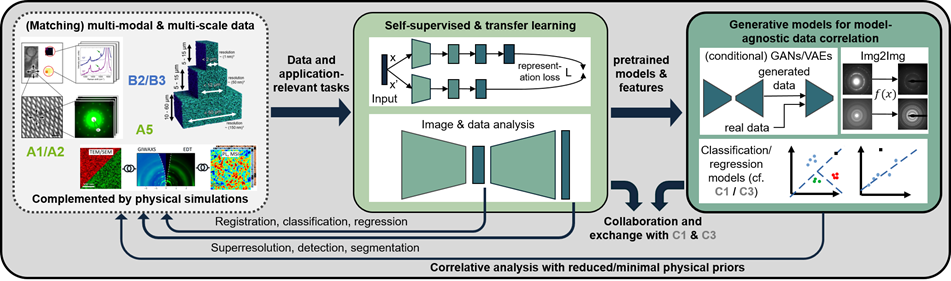
This doctoral project aims to develop artificial intelligence methods that accelerate the discovery and optimization of functional thin films through active learning. Building on the Sparse Symbolic Inference (SSI) framework, the candidate will train interpretable models that uncover simple, physically meaningful relationships between synthesis parameters, microstructure, and functional performance. Using features derived from microscopy and spectroscopy data, these models will predict key material properties and identify promising, unexplored regions in the materials space. Novel feature extraction methods—such as binary encoding for compressed representations—will be employed to handle sparse and heterogeneous datasets. The resulting predictive rules will form the basis of a closed-loop optimization workflow that guides targeted synthesis and characterization. This approach will enable data-efficient, explainable AI for materials design, linking microscopic descriptors with macroscopic functionality.

Supervisor

s

 
Prof. Dr. Luca Ghiringhelli Professorinnen und Professoren Mail Luca Ghiringhelli
Friedrich-Alexander-Universität
Erlangen-Nürnberg

Freyeslebenstraße 1
91058 Erlangen
  • Impressum
  • Datenschutz
  • Barrierefreiheit
  • BlueSky
  • Facebook
  • RSS Feed
  • Xing
  • YouTube
Nach oben